39 Out of 5 Stars 163 Reviews Sony Kd55x720e 55-inch 4k Ultra Hd Smart Led Tv (2017 Model)
Test Results
Design

Curved No
The Sony X720E has a similar design to most other Sony TVs. Information technology has the iconic fundamental stand which supports the Tv set well and has a pocket-sized footprint. Annotation that the 43" model nosotros reviewed and the 49" model both accept an external power brick, but the 55" model does not. This may make the smaller sizes a bit more difficult to wall-mount depending on your setup.

The stand of the X720E is very like to other Sony TVs. It has a fairly small footprint, and then fits well on most tables. Despite the small-scale footprint it feels sturdy and provides good support.
Footprint of the 43" Goggle box stand: 9.4" 10 21.9"

Wall Mount VESA 100x200
The rear of the Telly is quite basic, and the majority of it is plastic. Virtually of the inputs run parallel to the back of the Television and so are fairly like shooting fish in a barrel to access if wall mounted. At that place are a couple of inputs directly out the dorsum of the Television that may be difficult to use when placed close to a wall.
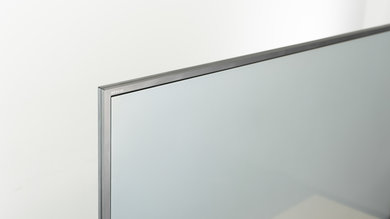
Borders 0.55" (1.4 cm)
The borders are quite sparse, and look good. They are black plastic, like the balance of the Television.
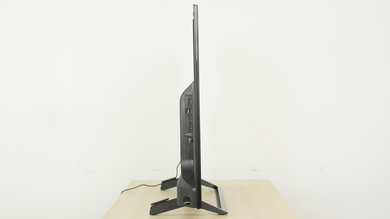
Max Thickness 2.76" (vii.0 cm)
The TV appears a bit thick when viewed from the side. The thickest role is near the base of operations of the Television, and equally such information technology may stick out a scrap if wall mounted.
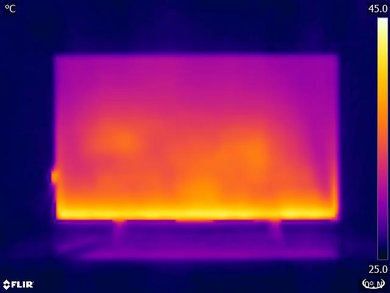
Maximum Temperature 109 °F (43 °C)
Average Temperature 93 °F (34 °C)
The bottom of the screen gets quite warm, but fortunately, the lesser of the frame only gets a little warm to the touch. Near of the Boob tube'southward vents are along the bottom and so this shouldn't be a problem.

The build quality is fine. The TV is about entirely plastic, just information technology still feels quite well made and potent due to the utilise of screws throughout the body, rather than simply mucilage or clips.
Picture Quality
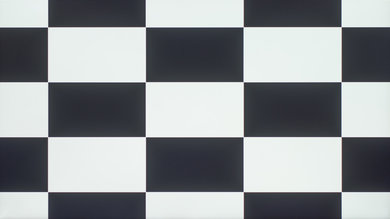
Native Contrast 907 : ane
Contrast with local dimming N/A
The contrast ratio of the Sony X720E is disappointing, even for an IPS TVs, which normally take a lower contrast ratio than VA TVs. When set in a night room, the low contrast ratio means that blacks look more grayish than actually black and dark scenes look washed out. Because of this low contrast ratio, the X720E is better suited for a bright room setting, where ambient light will prevent the low dissimilarity from being noticeable.
In comparing, this is a very similar result every bit the 2017 Sony X800E and the 2016 W600D, which both have a dissimilarity ratio between 900:1 and 1000:1.
Local Dimming No
Backlight Edge
The Sony X720E does not have a local dimming feature. The video is for reference only.
Update 11/29/2018: The X720E was incorrectly listed as having a Direct backlight. It is actually Edge-lit.
SDR Real Scene Summit Brightness 317 cd/m²
SDR Acme two% Window 340 cd/m²
SDR Acme 10% Window 342 cd/chiliad²
SDR Peak 25% Window 342 cd/m²
SDR Tiptop 50% Window 343 cd/m²
SDR Peak 100% Window 343 cd/m²
SDR Sustained ii% Window 340 cd/m²
SDR Sustained 10% Window 341 cd/m²
SDR Sustained 25% Window 341 cd/m²
SDR Sustained 50% Window 342 cd/1000²
SDR Sustained 100% Window 342 cd/m²
SDR ABL 0.000
Plot over time
Good SDR top brightness, practiced enough for a adequately vivid room. The effulgence also stays nearly constant no matter the content shown, which is great. Surprisingly, increasing the 'Contrast' setting from its default 90 to maximum raises the pinnacle effulgence past ~10%. The X720E is slightly less bright than the college tier X800E, roughly equal to the LG UJ6300 in 'Standard' mode, just far less bright than the TCL P607.
HDR Real Scene Peak Brightness 326 cd/m²
HDR Peak 2% Window 337 cd/k²
HDR Peak 10% Window 339 cd/m²
HDR Tiptop 25% Window 340 cd/grand²
HDR Acme fifty% Window 340 cd/m²
HDR Superlative 100% Window 341 cd/m²
HDR Sustained 2% Window 337 cd/m²
HDR Sustained 10% Window 338 cd/m²
HDR Sustained 25% Window 339 cd/m²
HDR Sustained 50% Window 340 cd/m²
HDR Sustained 100% Window 340 cd/m²
HDR ABL 0.001
Plot over time
Mediocre HDR peak brightness. Even though information technology is effectively identical to the SDR brightness, HDR demands higher brightness because highlights are mastered for 1000-4000 cd/chiliad², which is far brighter than this Television set is able to produce. On the plus side, the Television is very consistent with its brightness, which is good. Overall, the brightness is a little meliorate than the LG UJ6300, but worse than the Sony X800E and TCL P607.

50% Std. Dev. 2.498%
50% DSE 0.184%

5% Std. Dev. 0.427%
5% DSE 0.080%
The X720E overall greyness uniformity is skillful. The 50% gray uniformity exam movie shows some dark patches on each side of the screen, merely also that, the screen is pretty fifty-fifty, which is great since dirty screen effect is very limited and non really a problem.
Looking at the 5% grey examination picture, not much comes up which is good and no issues can exist seen here.
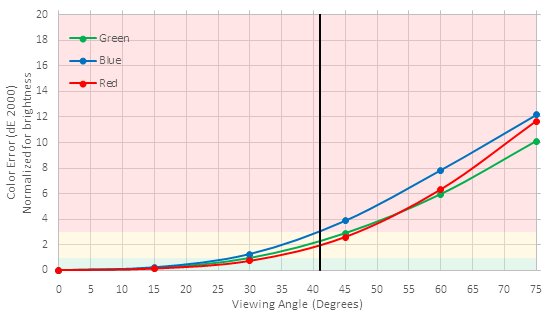
Color Shift 41°
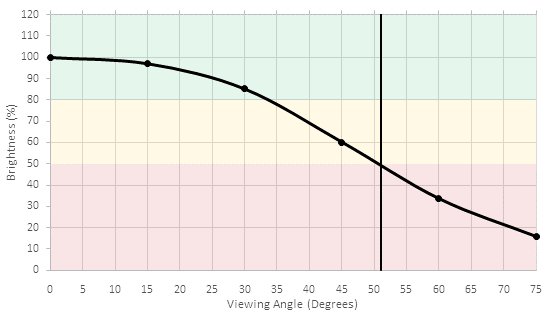
Brightness 51°
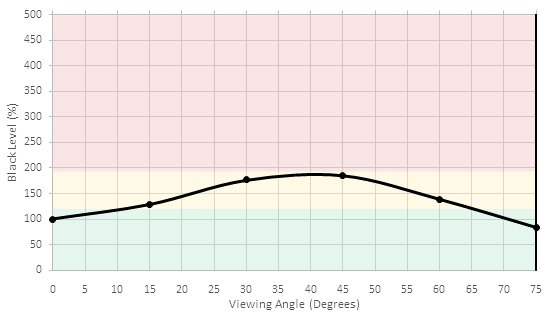
Blackness Level 75°
Good viewing bending, better even than most other TVs with IPS panels like the LG UJ7700. The black level stays fairly consequent at an angle which is great, while colors shift and effulgence decreases when viewed from a large angle. This TV is a slap-up fit for a room where people often sit to the side of the Tv set and view it at an angle.
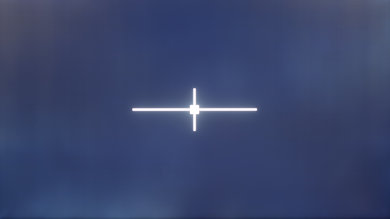
Native Std. Dev. 2.785%
Std. Dev. w/ Fifty.D. North/A
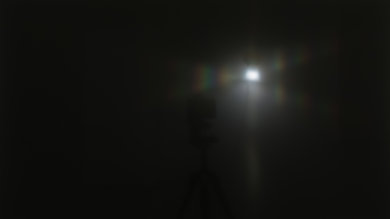
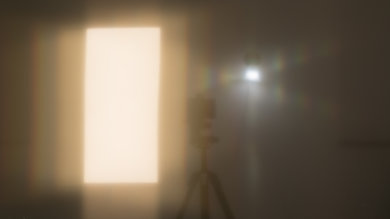
The X720E has a poor black uniformity. Flashlighting is visible on both top corners and also on the lesser left side. Note that in this test the black level is not taken into account, only the screen uniformity.

Screen Finish Semi-gloss
Total Reflections 5.6%
Indirect Reflections 2.0%
The reflection handling of the Sony X720E is decent. Information technology has a semi-gloss finish which diffuses reflection across the screen but besides reduces their intensity. It is fine for an boilerplate room merely may be an issue in a vivid room.
Information technology is the best budget outdoor TV we've tested, just since this Telly wasn't intended for outdoor utilize, so it is important to take a proper enclosure for outdoor utilize.
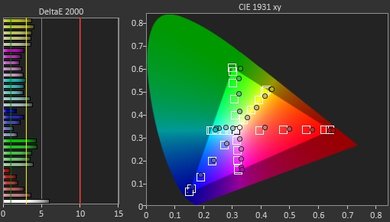
Motion picture Mode General
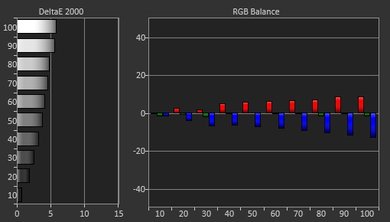
White Residue dE iii.71
Colour dE 3.01
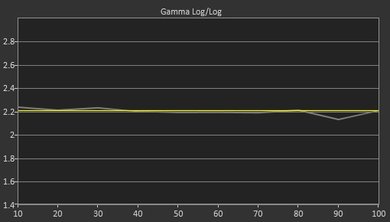
Gamma 2.xix
Color Temperature 5,871 K
The X720E has a decent accuracy even without calibration when the 'Scene Select' is set up on 'General', the 'Picture Mode' set to 'Full general' and the 'Color Temperature' gear up to 'Expert ane'. Other colour temperatures like 'Expert 2' and 'Warm' are in the aforementioned range of accuracy, but 'Neutral' and 'Cool' are the more inaccurate by far. The white rest dE is a flake high and tending toward the warm side, with the brighter IRE being more afflicted. Gamma is non likewise off, tracking close to our 2.2 target.
The colour dE is a scrap better than the white balance dE and more of the issues could be related to the fact that the white point is a bit off target and every bit so, the rest of the color are all globe-trotting in the aforementioned direction. But even with this, the colour accurateness is even so acceptable.
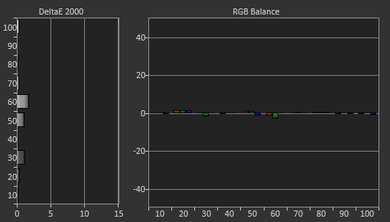
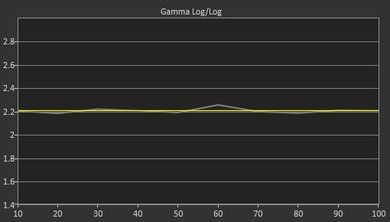
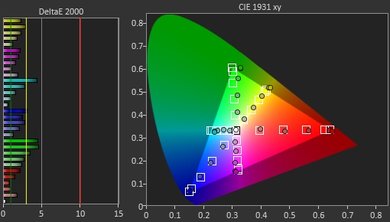
Picture Way General
White Balance dE 0.54
Color dE ii.xviii
Gamma ii.20
Color Temperature 6,492 K
Subsequently scale, the X720E is very accurate. The white balance dE was brought down to 0.54, which is imperceivable. The but trouble that came up in the scale was that some IRE point control (5 and vi) were overlapping each other, making information technology very difficult to conform them correctly. This is reflected on our white residuum calibration prototype, where the l and 60 betoken have a higher dE than the rest. Later on calibration, the gamma was too spot on our two.ii target, with once more the little bump nigh the l and lx IRE.
Like near of other Sony TVs, there is no color management arrangement and every bit such, the only correction to the color accuracy was washed via the white residuum calibration. The white residual did correct the white point and well-nigh of the color repositioned themself with the same correction and the dE was brought down a bit, to achieve 2.18, which is proficient plenty that even the enthusiasts would not actually notice the colour inaccuracy.
You can run into our recommended settings here.

Upscaling of DVDs or other low-quality content is adept. Lines aren't smoothed as much as some other TVs but this helps to retain details.
720p content such every bit cable looks good. Some more artifacts from the camera are visible in the photograph, simply this isn't nowadays on the Idiot box. Very few haloing artifacts are visible.

Total-Hard disk sources such as Blu-rays are upscaled well. The epitome remains sharp and details are preserved.

No problems can be seen when displaying native 4k content.
Wide Color Gamut No
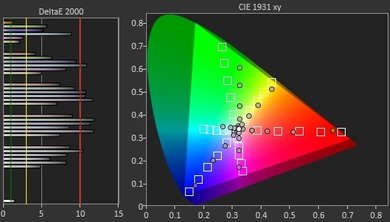
DCI P3 xy 71.96%
DCI P3 uv 78.89%
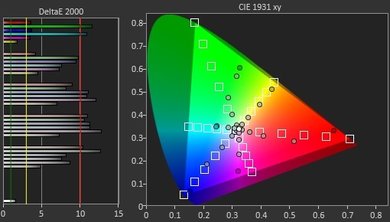
Rec 2020 xy 51.63%
Rec 2020 uv 57.49%
Standard colour gamut, merely good enough for SDR content using the Rec 709 color space. Deep colors in HDR content won't expect as saturated every bit intended, notwithstanding most of the scene volition accept reasonably accurate colors.
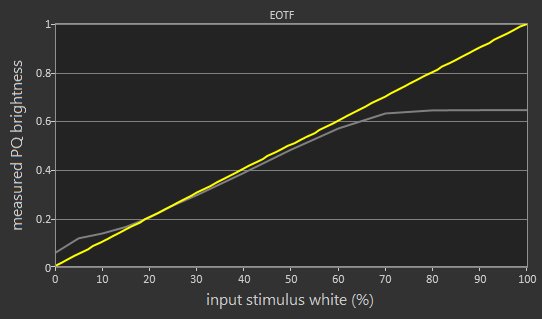
The EOTF in the 'HDR Video' flick mode of the 'HDR' 'Scene Select' follows the PQ curve fairly closely upwards until it clips at the Idiot box's peak brightness. Raising the 'Gamma' setting to max raises the EOTF nicely and brightens most everything, equally shown here, making it useful for watching HDR content in a bright room. HDR content is only shown properly in the 'HDR' 'Scene Select'; in any other 'Scene Select' such every bit Game and Graphics the EOTF follows the SDR gamma curve rather than the HDR PQ curve, making dim parts of the scene also vivid and bright parts besides dim.

Normalized DCI P3 Coverage ITP 56.iv%
10,000 cd/yard² DCI P3 Coverage ITP 23.three%
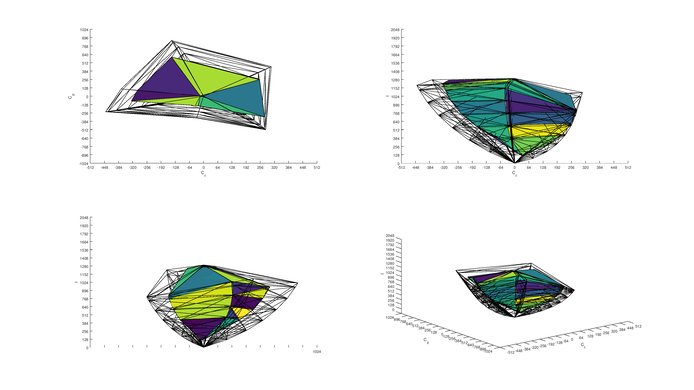
Normalized Rec 2020 Coverage ITP 44.4%
x,000 cd/thou² Rec 2020 Coverage ITP eighteen.3%
Poor color volume, by and large express by the Tv set's standard color gamut. The Telly'southward disappointing dissimilarity ratio also prevents it from accurately showing dark colors, every bit seen in the bottom of the color volume.
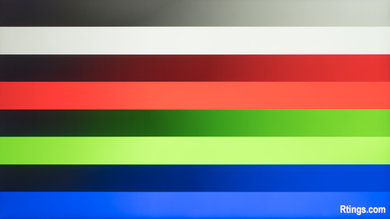
Colour Depth ten Flake
Ruddy (Std. Dev.) 0.115
Green (Std. Dev.) 0.110
Blue (Std. Dev.) 0.099
Grayness (Std. Dev.) 0.080
The Sony X720E does a decent job at displaying our gradient test prototype. Looking at our test picture, some bands are very visible, especially in the nighttime green and blue areas, but these obvious bands are fortunately few. With this TV banding won't be problematic when watching about content, such as HDR movies.
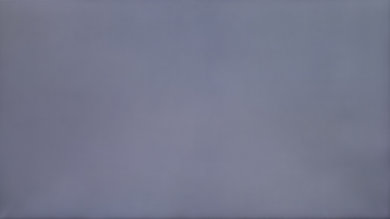
IR after 0 min recovery 0.00%
IR after ii min recovery 0.00%
IR later on 4 min recovery 0.00%
IR later on vi min recovery 0.00%
IR afterward 8 min recovery 0.00%
IR subsequently ten min recovery 0.00%
The X720E does not endure from epitome retention at all and this is very interesting as this Boob tube has an IPS panel, which often suffers from image retention. This is a very like consequence every bit seen on the Sony X800E, which is too an IPS Television set but does not endure from image memory.
Permanent Burn-In Risk No
Although some IPS panels can suffer from temporary image retentivity, this doesn't appear to be permanent equally seen in our long-term test.
Move

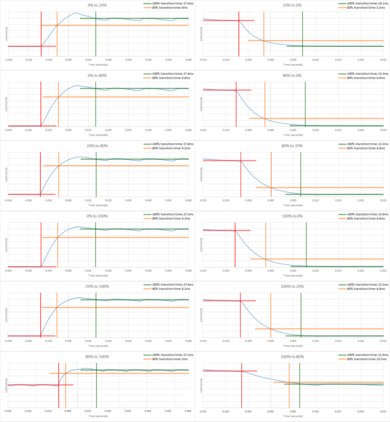
80% Response Time 7.5 ms
100% Response Time 20.8 ms
Response fourth dimension for the X720E is good, resulting in curt trails following moving objects. This is skillful when watching fast-paced content. The LCD panel response is like to the X800E, but this Tv overdrives the pixels more than, which causes some overshoot in all of the low-to-high transitions.
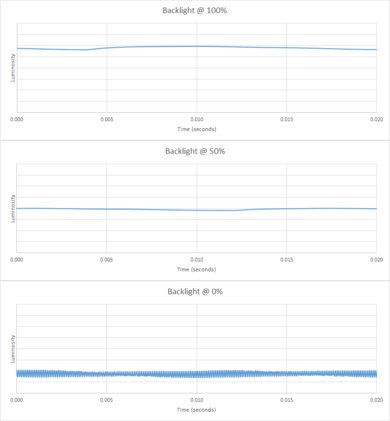
Flicker-Free Yes
PWM Dimming Frequency 0 Hz
Like nearly Sony TVs, the X720E doesn't flicker, and instead shows each image for a total frame. Oscillations at a frequency of 10 kHz appear at depression backlight settings, but this is much too fast to be noticeable without specialized equipment. The absence of flicker makes motility announced slightly smoother, but does result in persistence blur.
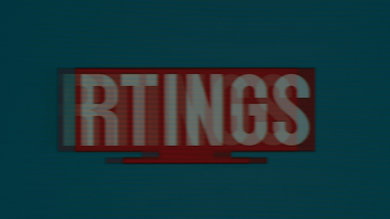
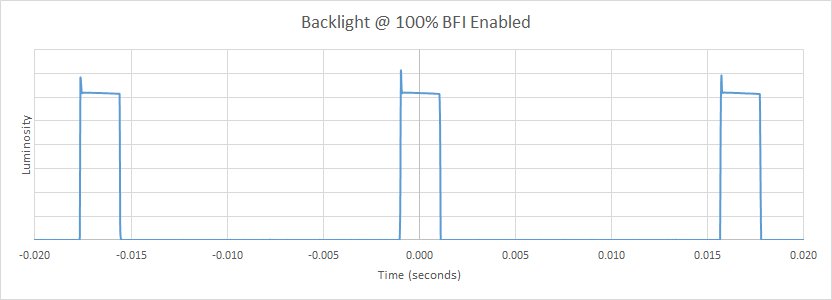
Optional BFI Yeah
Min Flicker for 60 fps 60 Hz
60 Hz for threescore fps Yes
120 Hz for 120 fps N/A
Min Flicker for 60 fps in Game Mode 0 Hz
Information technology is possible to add together 60Hz or 120Hz backlight flicker, which helps to reduce persistence blur. To add 120Hz flicker, set the 'Motionflow' option to 'Custom', and move the 'Clearness' slider to 'i'. To clear up motion even more with a 60Hz flicker, set the 'Clearness' slider to 'Max'. Notation that the BFI option on this TV has a very short duty cycle, which dims the image considerably when the Clearness choice is enabled.

Move Interpolation (30 fps) Yes
Motility Interpolation (sixty fps) No
The Sony X720E has a 60Hz panel which tin can interpolate lower frame charge per unit content. To enable interpolation, fix 'Motionflow' to 'Custom' and increase the 'Smoothness' slider. Note that any motion interpolation will introduce artifacts, then apply a small value unless you really like the lather opera effect. Interpolation on the X720E showed more artifacts than normal on our examination design, so a low Smoothness value is recommended.
Frame Concord Time @ 24 fps twenty.9 ms
Frame Hold Time @ 60 fps 0.0 ms
The Sony X720E is great at producing a polish prototype, without stutter. This is because the pixel response time smooths the image between what would exist jarring frame changes. For the worse case scenario of long panning shots in low frame rate movies it may exist noticeable, merely otherwise the image is smoothen.
Judder-Free 24p Yeah
Judder-Free 24p via 60p No
Judder-Gratis 24p via 60i No
Judder-Gratuitous 24p via Native Apps No
The X720E can just display 24p movies without judder when those movies are played via 24p sources like DVD or Blu-ray players and this without the demand to turn on any specific option from the picture show setting. On the other manus, the Tv can't correctly brandish at the right cadence 24p movies playing via 60p/60i sources similar cable/satellite boxes. When the 'CineMotion' turned on or set to 'Auto', the Tv set did actually try to change the cadence but was not able to correctly display information technology as seen in this moving-picture show.
Native Refresh Charge per unit sixty Hz
Variable Refresh Charge per unit No
4k VRR Maximum N/A
4k VRR Minimum N/A
1080p VRR Maximum Due north/A
1080p VRR Minimum Due north/A
VRR Supported Connectors Due north/A
Equally with other 2017 TVs, the X720E doesn't back up a variable refresh rate.
Inputs
1080p @ 60Hz nineteen.7 ms
1080p @ 60Hz + HDR nineteen.vii ms
1080p @ 60Hz Outside Game Mode 121.0 ms
1080p @ 120Hz Northward/A
4k @ 60Hz xix.8 ms
4k @ 60Hz + HDR 19.7 ms
4k @ 60Hz @ 4:4:4 eighteen.7 ms
4k @ 60Hz @ iv:4:4 + 8 bit HDR Due north/A
4k @ 60Hz Exterior Game Style 120.8 ms
4k With Interpolation 120.viii ms
4k @ 120 Hz N/A
4k with Variable Refresh Rate Due north/A
1080p with Variable Refresh Charge per unit North/A
Update 10/18/2017: There is currently a bug on the Sony X720E that causes the input lag to rise later the Television receiver is restarted. To make use of the depression input lag, it is necessary to modify picture mode to something other than "Game" or "Graphics" and so back to either for them to function properly.
Update 12/28/2017: The input lag bug is now fixed in firmware v4.503, which you can download hither.
First-class low input lag, which will please all but the most competitive gamers. Both the Game and Graphics 'Scene Select' modes always take depression input lag and testify iv:4:4 colour properly, but never show HDR content properly. The 'HDR' 'Scene Select' surprisingly has depression input lag as long as 'Motionflow' is turned off, merely information technology does not bear witness 4:4:4 color properly. Overall the input lag is significantly lower than nigh all Sony TVs, and roughly equal to Samsung TVs, simply a little college than most TCL and LG TVs.
1080p @ 60Hz @ 4:iv:four Yes
1080p @ 120Hz No
1440p @ 60Hz Yes
4k @ 30Hz @ four:four:4 Aye
4k @ 60Hz Yes
4k @ 60Hz @ iv:4:4 Aye
4k @ 120Hz No
The TV supports most common resolutions. 4k @ lx Hz @ 4:4:iv or 4:2:2 color is only supported on HDMI inputs 2 and 3, and only when 'HDMI Signal Format' is set to 'Enhanced'. 4:four:4 colour is only displayed properly in the 'Game' and 'Graphics' modes in 'Scene Select'. 'Graphics' mode is recommended for PC monitor employ as the Goggle box's CE dimming is completely disabled. HDR content is but displayed properly in the 'HDR' 'Scene Select', which unfortunately does not display iv:4:4 colour properly.


HDMI 3
USB 3
Digital Optical Audio Out ane
Analog Sound Out 3.5mm one
Analog Audio Out RCA 0
Component In 1 (incl. adapter, shared)
Composite In i (incl. adapter, shared)
Tuner (Cable/Pismire) 1
Ethernet 1
DisplayPort 0
IR In 0
SD/SDHC 0
HDR10 Yep
Dolby Vision No
HLG Aye
3D No
5.1 Passthrough ARC Dolby Digital Yep
5.ane Passthrough ARC DTS Aye
5.i Passthrough Optical Dolby Digital Yep
5.1 Passthrough Optical DTS Aye
HDMI 2.0 Full Bandwidth Yes (HDMI 2,3)
HDMI 2.ane Total Bandwidth No
ARC Yeah (HDMI iii)
USB 3.0 No
HDCP 2.two Aye (HDMI i,2,iii)
CEC Aye
MHL No
Variable Analog Audio Out Yes
Wi-Fi Support Yeah (2.4 GHz)
HDR is just displayed properly in the 'HDR' 'Scene Select'. HDR content is detected when 'Scene Select' is set to 'Car', and the Idiot box changes to 'HDR' automatically. When HDR content is viewed in any other 'Scene Select' it volition not exist displayed properly (darks will exist likewise bright, brights will exist too dark, etc).
Audio Quality

Low-Frequency Extension 142.54 Hz
Std. Dev. @ 70 half dozen.86 dB
Std. Dev. @ 80 6.87 dB
Std. Dev. @ Max 7.xvi dB
Max 97.one dB SPL
Dynamic Range Compression two.65 dB
Poor frequency response. The X720E has a strong overemphasis on lower frequencies and a very poor bass extension, causing it to sound dirty and to lack clarity. At 97.1 dB of maximum volume though, it does go fairly loud for a Tv set.
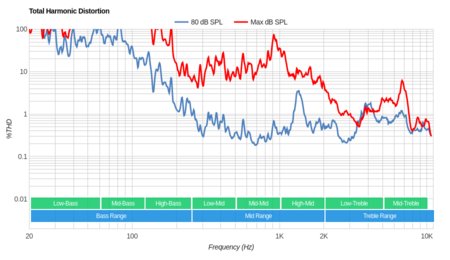
Weighted THD @ lxxx 0.081
Weighted THD @ Max 16.588
IMD @ 80 0.77%
IMD @ Max 31.74%
Mediocre baloney performance. While it does decently at lower volumes, THD levels spike up with higher volume settings reaching noticeable levels.
Smart Features
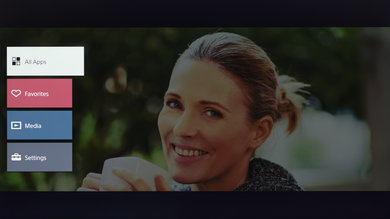
Smart OS Custom Sony
Version N/A
Ease of Use Not Easy
Smoothness Very Shine
Time Taken to Select YouTube 4 southward
Fourth dimension Taken to Change Backlight four s
Avant-garde Options Many
The Television set's interface has no animations and is very responsive, so navigation is fast. Nevertheless, it has some very unintuitive organisation choices, generally involving the picture settings. When content is playing, there is an 'Options' menu containing quick settings. The first item is 'Picture show Adjustments' and the 6th item is 'Scene Select', yet the contents of 'Motion picture Adjustments' depend on which 'Scene Select' (ex Car, Game, Movie, HDR) is agile. In that location is also a 'Motion-picture show Mode', which is easily confused with 'Scene Select'. There is no indicator that content is playing in HDR, and HDR is only displayed properly in the 'HDR' Scene Select, so information technology's possible to play HDR content in a different Scene Select and have it shown improperly (darks too light, brights too dim) without knowing this is happening. Leaving 'Scene Select' on 'Motorcar' should avoid most of these cases, just it's still a very unintuitive way to organize picture settings.
When changing channels or inputs there is an info bar that displays the video information at the top of the screen. This bar cannot exist disabled and appears whatsoever fourth dimension there is a change detected (navigating through Netflix, changing channels on an Apple Telly, etc..).
Ads No
Opt-out N/A
Suggested Content in Dwelling No
Opt-out of Suggested Content N/A
The TV has no ads in its primary interface or suggested content in its domicile screen, which is great.
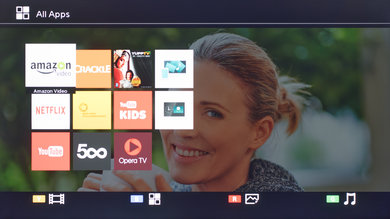
App Selection Not Many
App Smoothness Average
Bandage Capable Yes
USB Drive Playback Aye
USB Bulldoze HDR Playback Yes
HDR in Netflix Yes
HDR in Amazon Video Yeah
HDR in YouTube Yes
The TV has a few apps built in, such equally Netflix, YouTube and Amazon Video. It too has the OperaTV app store, which doesn't accept many major apps.
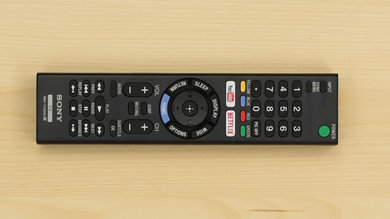
Size Large
Vox Command No
CEC Menu Control Aye
Other Smart Features No
The remote is large with many buttons like other Sony remotes, just information technology has no smart features such every bit voice control. It is fairly lite for its size, just its build quality isn't very good and its safety chunk buttons aren't as easy to press equally the buttons on other remotes. Overall it's very like to the remotes of the X800E and X850E, but without phonation control and with some button differences due to their different smart platforms.
Acts as the Remote No
Direct Launches Apps and Inputs No
Inputs Text in YouTube No
Inputs Text in Netflix No
Streams Device Files Express Support
Controls Goggle box Settings No
Phonation Control No
The Idiot box has no official remote app, just it does have a 'Photograph Sharing Plus' feature. The TV creates its own Wifi Direct connection with a device, then provides a web address containing a spider web app that tin play the device'south own images and music files on the Television receiver. One limitation of this is that the device must disconnect from their wifi internet in order to connect to the Television receiver'due south Wifi Direct, which can be inconvenient.
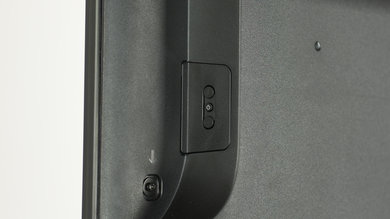
The TV has three physical buttons. A short press on the heart push button changes between inputs and volume functions, while the upward and down arrows increment the function. A long printing on the center button turns the Television receiver on and off.
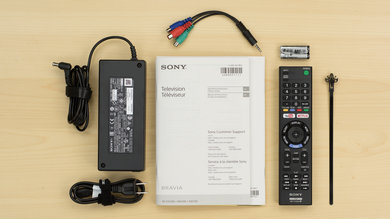
- Manual
- Batteries
- Remote
- External power brick
- Power cable
- Cable management strap
- Component adapter
Ability Consumption 38 W
Power Consumption (Max) 76 Westward
Firmware 4.421-1.080-05
Differences Between Sizes And Variants
We tested the 43" (KD43X720E). For the most part, we look our review to exist valid for the 49" (KD49X720E) and 55" (KD55X720E).
If someone comes across a different type of panel or if their Sony X720E doesn't correspond to our review, allow united states know and we will update the review. Different the 43" and 49" models, the 55" variant has an internal power brick.
| Size | Model |
| 43" | KD43X720E |
| 49" | KD49X720E |
| 55" | KD55X720E |
Compared To Other TVs

Top left: Vizio K Series 2017 (M65-E0). Lesser left: Sony X800E (XBR43X800E). Middle: Sony X720E (KD43X720E). Tiptop right: Samsung MU7000 (UN55MU7000). Lesser right: TCL P607 (55P607). Different our other photographs, this picture wasn't taken nether a controlled environs, so practice not depict conclusions from it.
The Sony X720E offers decent value overall compared to most of its contest. It doesn't have the best picture quality, just information technology's still a skilful choice for some usages. See our recommendations for the all-time cheap TVs and the best flatscreen TVs.
43" 49" 55"
The Sony X720E is slightly better than the Sony X800E. The Sony X720E has improve input lag, and this is smashing for gaming or for use as a PC monitor. Also, the Sony X720E has slightly meliorate gray uniformity which is not bad if you lot picket a lot of sports. The Sony X800E has better smart features and reflections that you will appreciate if you watch TV shows in a brighter room.
50" lx" 70"
The Sony X690E is a bit better than the Sony X720E for nearly users, unless yous have a broad seating arrangement. The X690E uses a VA panel, which performs better in a nighttime room thanks to the improve contrast ratio and much ameliorate blackness uniformity. The X690E likewise has meliorate reflection handling and a faster response time. The X720E uses an IPS console which has much wider viewing angles and is a bit brighter.
58"
If you have a wide seating arrangement, and so the Sony X720E is a better choice since it has better viewing angles. The Sony X720E as well has better 24p judder removal, which is keen for movie lovers, and slightly better gray uniformity which will please sports fans. The Samsung MU6100, on the other hand, has much better contrast and somewhat better blackness uniformity that is smashing for watching movies in a dark room, and better reflections and smart features for those who savor Goggle box shows in brighter rooms.
40" 43" 50" 55" 58" 65" 75"
The Samsung NU7100 is a chip amend than the Sony X720E, unless you have a wide seating area. The NU7100 uses a VA panel, and is better for a direct seating arrangement but has meliorate nighttime functioning due to the better dissimilarity and better black uniformity. The X720E uses an IPS console which has much wider viewing angles but isn't recommended for a dark room.
+ Show more
Source: https://www.rtings.com/tv/reviews/sony/x720e
0 Response to "39 Out of 5 Stars 163 Reviews Sony Kd55x720e 55-inch 4k Ultra Hd Smart Led Tv (2017 Model)"
Post a Comment